Based on a novel by Kakuta Mitsuyo, and thoroughly grounded in her novel’s visionary exploration of female and maternal identity, REBIRTH will take you to unexpected places. Bringing to mind several Japanese films and series about kidnapping (MISSING, MY FAMILY, SINCE I TOOK YOU), in director Narushima Izuru’s REBIRTH the emotions are the most raw and revealed as generations are caught up in repercussions of cruelties and crimes.
Nagasaku Hiromi anchors the many fine performances as Kiwako, a woman on the run whose actions upend many lives. The actress’ ability to embody love and desperation and her chemistry with her child Kauru (Watanabe Konomi) make the film watchable. Less emotive, but believable, Inoue Mao plays the grown Kauru on a search for truth and meaning. Koike Eiko (TOKYO SWINDLER, NHK taiga drama THIRTEEN LORDS OF THE SHOGUN) turns in one of her finest performances as Chigusa. Yo Kimiko (SHIN GODZILLA, NHK taiga drama ATSUHIME) as Angel and Moriguchi Yoko (WHISPER OF THE HEART, THE SHOPLIFTERS) as Etsuko are effective in supporting roles.
As the film opens to courtroom drama and various confessions erupt, I am led to wonder if we the audience will be escorted on a tour of human sufferings, to question who is responsible. In fact, deeper questions will arise and unexpected characters will emerge from the frozen ground. Both the English title and the original Japanese title are appropriate to headline this story, each in their own way. Characters ruminate over the curious life cycle of cicadas, which hatch onto the earth’s surface for only seven days. Is it a mercy they will die together? What if a lone survivor outlasts his kind? What then will the world have to offer?
The film’s narrative, grounded in its literary source, keeps its focus laser-like on the questions in its characters’ hearts. REBIRTH does not have any kind words for the male of the species, though its assorted cruelties come from all directions. The film does offer a unique perspective on female resilience.
Wakamatsu Setsuro’s SNOW ON THE BLADE concerns the fallout from one of the most dramatic incidents in 19th century Japanese history–the assasination of Lord Ii Naosuke by a gang of revolutionaries. A powerful minister from a family who served the Tokugawa shoguns for generations, Lord Ii angered anti-westerners by agreeing to open ports to American trade and by cracking down brutally on the pro-Imperial factions who wanted power returned from the Tokugawa shoguns to the Imperial court. Lord Ii turns up in many films and television shows and is often depicted as a cultured gentleman whose personal charm and sincere dedication to his job belies the torture and executions his regime pursued. We meet the character of Shimura Kingo (Nakai Kiichi), a rather simple lowly samurai with impressive sword skills who is so taken by Lord Ii’s graceful demeanor that he instantly pledges his loyalty. Employed as senior bodyguard, he will live with shame from his ineffectual role as on that fateful day. Nakai Kiichi was excellent as the Mito lord in SAMURAI ASTRONOMER and the father of Kiyomori in the NHK taiga drama, KIYOMORI. He also starred in the NHK drama SHINGEN in 1988.
The entire Ii-Hikone clan is scandalized by the event. The Shimura family is treated brutally and Kingo enters into a state between life and death where he is judged too guilty to be allowed to die until he tracks down the remaining killers. History throws a major wrench into his mission when, in a few years time, Japan endures a brutal civil war, the shogun abdicates, and the Emperor regains total authority over the nation. Emperor Meiji’s council of ministers (mostly former revolutionaries) did away with the feudal system, banning swords in public, westernizing industry and the military and even discouraging citizens from wearing traditional robes. Kingo becomes a walking anachronism as he obsessively wanders Tokyo with his swords intact. The film skips over the even worse fates which the other failed bodyguards suffered.
Abe Hiroshi plays kingo’s quarry, Sahashi Jubei, in a moving performance. The two characters share the experience of living in limbo and waiting for death each day. For decades, Abe has been one of Japan’s busiest actors known for his many fine lead performances in productions such as IN THE WAKE, the TRICK series, CLOUD UPON THE HILL, and BEFORE WE FORGET EVERYTHING. Nakamura Kichiemon is great as Lord Ii. Hirosue Ryoko (DEPARTURES, NHK taiga drama RYOMADEN) plays Kingo’s suffering wife and channels through her haggard demeanor the frailty contrasting with her youth. Veteran actor Takeshime Masahiro charms as Kingo’s old friend Shinnosoke. There is a great child actor in the role of Jubei’s neighbor.
The film features an unusually subdued score by Hisaishi Joe of Studio Ghibli fame. Nighttime cinematography, something so many films fail at, shines in SNOW ON THE BLADE.
After a strong prologue with clarity of purpose, SNOW yields to chaotic montages while Kingo wanders. There are rather abrupt time shifts so it is hard to tell if we are in Edo Japan or Meiji Japan. Time stamps are inconsistent. Better editing could have fixed this problem.
Revenge films depend on setting up the backstory of the wronged party and SNOW succeeds in grounding that story in the main character. Because of the thorny moral issues and because of the abrupt shift in government and national priorities, the audience will never be certain whose side we are on. Nakai factors this into his performance and it is a key feature of the storytelling that unfolds.
The theme of clinging to the past comes up over and over. There is a great scene when numerous former samurai come together to reinforce their bushido values. The film poses a question about inner values vs outer appearance. Yet Kingo’s quest for honor is a quest for killing. This is not lost on some characters or on the audience. Early on his friend Shinnosuke tells Kingo there is “not a political bone in you.” He is a simple man, but he does have years to ponder the worth of his quest.
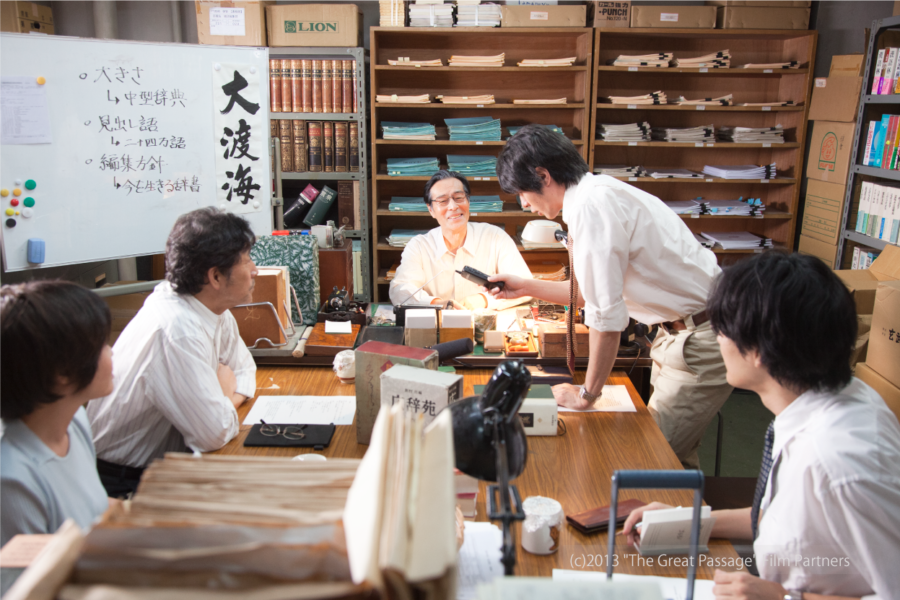
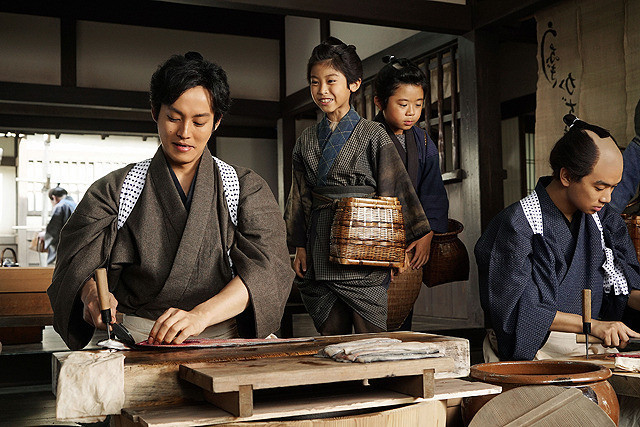
“Flipping through books so much your fingerprints wear off is a joy.” These words are spoken by a senior editor at the small Tokyo publisher at the center of this story. Based on the novel by Miura Shion, THE GREAT PASSAGE is an inspirational story about men and women who made their life’s work the creation of a new kind of dictionary. The film flows along as mellow as its color palette. Set in the 1990s and filmed in Kodakesque hues, the film slowly beckons you into its quirky environments and relationships. Cinematographer Fujisawa Junichi really knows how to photograph books: big books, small books, coffee table books, walls of books, piles of books. It would have been fun to see the design department build up each set from book-cluttered bedrooms to the labyrinthine dictionary office.
Matsuda Ryuhei stars as Majime, a maladjusted word nerd perfect for his new job in the dictionary department. He immediately catches the infectious enthusiasm of his superiors. There will likely be many viewers for whom the prospect of this kind of inspired workplace offers the same wish fulfillment Diagon Alley might for Harry Potter fans. Matsuda was excellent in QUARTET, ASURA, and THE MAGNIFICENT NINE. Miyazaki Aoi (ATSUHIME, TENCHI: SAMURAI ASTRONOMER) is excellent as Hayashi, a young chef starting her life over in Tokyo, whose nighttime ritual of sharpening knives is not so much menacing as obsessive. Odagiri Joe is great as Majime’s sarcastic colleague Nishioka, who is worldly in all the ways Majime is not, including being experienced with women. Kobayashi Kaoru (MIDNIGHT DINER, 1972, and the NHK taiga drama NAOTORA) and Kato Go (DEATH OF A TEA MASTER, CLOUDS OVER A HILL), both veterans of the big and small screens are great as the seasoned editors.
Watanabe Takashi provides an intriguing score, here somewhat jazzy on piano and vibraphone, with minimalist but impertinent brass, always eclectic.
The filmmakers methodical process mirrors that seen on screen. For a dictionary that was projected to take years to complete, unsurprisingly time will lapse and move on. The film takes a sudden turn into new territory with the addition of Kuroki Haru (excellent in the NHK taiga dramas SEGODON and SANADA MARU) as a young female addition to the dictionary staff. Her character feels a little shortchanged in the narrative. Just as soon as she arrives, we are steeped in an editorial crisis that serves as a tense climax for the film as publishing deadlines loom. Overall, THE GREAT PASSAGE is a slow character study in a genre that we might define as workplace drama. Extra points for some wonderful cat actors.
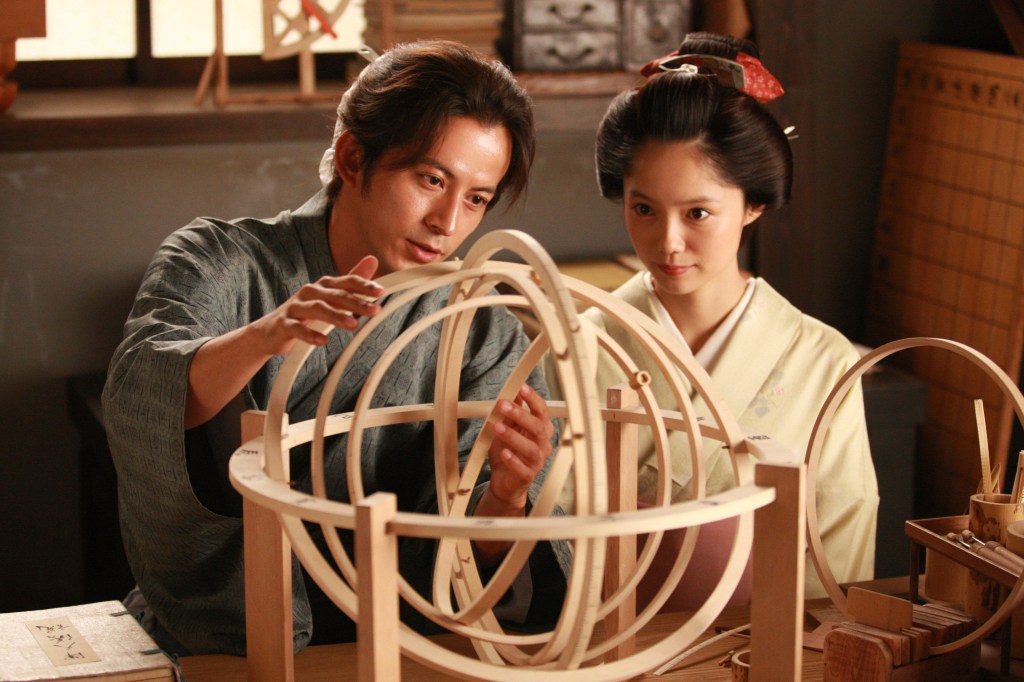
Based on a true story, director Takita Yojiro (DEPARTURES, WHEN THE LAST SWORD IS DRAWN) brings us an absorbing biopic about human perseverance and the struggle for science against ignorance and superstition. Okada Junichi turns in one of his finest performances as Santetsu Yasui, a young man living in the late Edo period whose left-brained skill at board games, puzzles, and mathematics impresses everyone around him. In the first part, Okada acts young, pitching his voice higher, swaddled in ill-fitting clothes that make him look undersized. Gradually, the character matures into the kind of heroic samurai who is willing to stake his life on his mission. His passion and impatience for learning offsets his dry nerdy demeanor perfectly.
Tense games of Igo (an ancient East Asian strategy game consisting of black and white stones on a grid) presage more dangerous combats to come. Will TENCHI deliver the usual swordplay that samurai films all promise? We shall see, but we must also keep an open mind about what constitutes combat: martial, political, and cultural.
From the start, much is made of the celestial inspiration, indeed the heavenly shape that mathematics and especially geometry impart to puzzles. If we look closely at the narrative we may detect ever-widening circles of relevance: from puzzles to Igo matches to marching across Japan in order to measure the realm. Finally we must solve with Santetsu the grandest problem: tracing Japan’s progress through the cosmos with an accurate calendar. Santetsu must do in a short time what the West has accomplished over centuries (a theme found in many Japanese stories set in the later Meiji era). He will abandon the eight century old Chinese calendar. Appropriately this journey unfolds across all seasons, all weather. Alpine summits and beautiful shrines enchant the eyes. Makeshift observation decks pop up across Japan shielded by the kind of heraldic cloth fencing associated with war camps.
No less than HisaishiJoe, famous for his many Studio Ghibli films, scores TENCHI. One theme stands out the most, a metronomic march that perfectly matches the precision movements of these samurai scientists as they ambulate across the landscape counting their steps like a primitive sports watch.
Miyazaki Aoi plays En, the eligible sister of one of Santetsu’s learned friends. Miyazaki and Okada have great chemistry, not surprising considering that they went on to marry in real life. It will have been a huge challenge for the filmmakers to fit this epic journey into the frame of a love story. Did they succeed?
The always-excellent Sometani Shota shows up as shogun Tokugawa Ietsuna. Controversial actor Ennosuke Ichikawa turns in a fine performance as antisocial math genius Takakazu Seki. Yokoyama You shines as Dosaku, a monk considered the greatest Igo player in Japanese history. Oddly enough, the great Yoshioka Riho appears in her first filmed role as an extra. If you look very closely you might spot her in the crowd waiting for an eclipse of the sun.
Like all scientists, Santetsu has to slay sacred cows. His fight is not without risk. Born into the peaceful Edo period when the Tokugawa shoguns exercised complete control over regional lords and commoners, Santetsu comes to believe that fresh ideas have been wiped out. Interestingly, it is not the shogunate standing against progress, but the nobles of the Imperial court. Decades later, Japanese reformers would harness imperial power to overthrow the shogunate, but that is a different story.
Gorgeous cinematography by Hamada Takeshi (DEPARTURES, KUBI) transports us into the era. Ominous eclipses, crows taking flight: the filmmakers transfigure these disturbing tropes to presage not moments of horror but breakthroughs of scientific advancement.
TENCHI: SAMURAI ASTRONOMER is the most important in a new breed of quirky samurai film. Although long, detailed, and requiring an investment of attention from the audience, it is a superlative film. Like samurai scientist Yasui Santetsu, the filmmakers proved they had “perfect insight” and “perfect vision.”
Limited series, (4 episodes) starring Kitagawa Keiko and Yoshioka Riho
Strange Instruments of Mercy:
A recent mystery series showcasing two young stars of Japanese cinema and television. Like an onion, peeling back its layers will make you cry. Tears of disappointment? Or tears in solidarity to these grieving and resilient characters? I have been looking forward to seeing the female leads, Riho Yoshioka and Keiko Kitagawa, among the greatest in their generation of Japanese actors, work together. Like many WOWOW productions, the higher budget and studio guidance makes for a slicker, better photographed, moodier look, but with fewer episodes. The story does plumb the depths of human suffering, not afraid to examine the complex motivations behind destructive human behavior. The story inevitably serves as a just critique of Japan’s death penalty system, though it avoids offering that critique in a political way.
There is a meta distance between the main characters, who are filmmakers without a finished script, and the history of the past which they explore as content creators and almost like us, the audience, as viewers. This can slow down the immediacy of the story. With apologies to the source novel which I have not read, this script comes close to making the filmmaker protagonists as interesting as the crimes they investigate, but falls short.
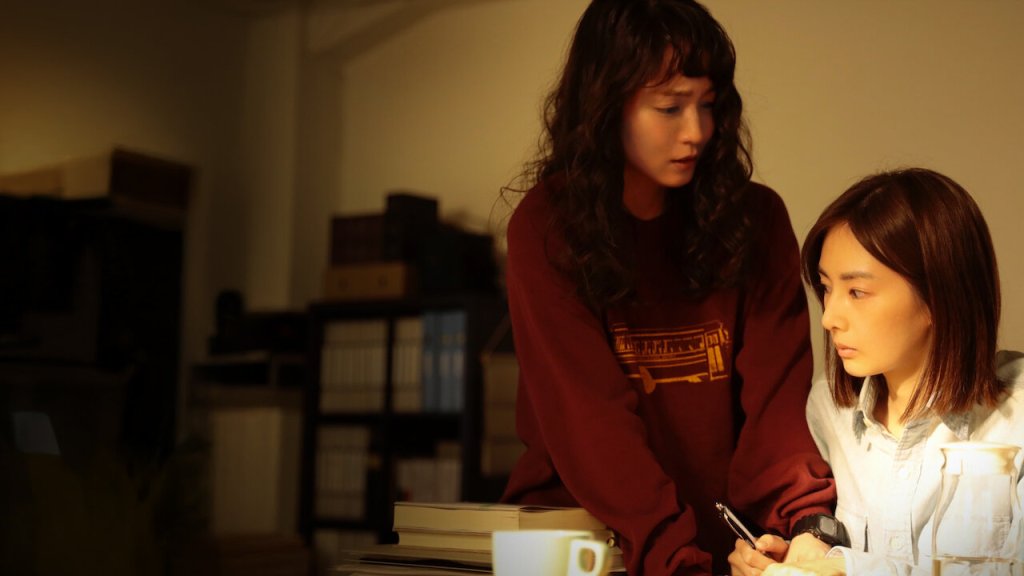
Yoshioka, as always, is able to do more with less, able to turn emotional repression into a slow simmering boil. Unfortunately, Kitagawa’s considerable talents lie elsewhere. Take, for example, her turn as a grief stricken and half crazed mother in SINCE I TOOK YOU AWAY. The producers of the recent NHK Taiga Sengoku biopic: WHAT WILL YOU DO, IEYASU wisely cast her as the infamous Lady Chacha, and she delivered one of the best versions in years (Chacha, Lady Yodo was the niece of Odo Nobunaga and mother of Toyatomi Hideyoshi’s heir, whose influence over both may have soured an already turbulent era. Kitagawa always has an elfin and diminutive appearance. Yet when she performs wide-eyed characters of Shakespearean scope, she can really pull it off, even when chewing the scenery. Yet here the production calls for her absolute austerity. Opposite her, Yoshioka has been turned into the plainest Jane they can make of her, under a mop of curly hair and bereft of a shred of glamor. At times I could not help but imagine their casting reversed. I have no doubt that version would also have been watchable. It may have been an imposition upon the viewer to follow two leads who were equally stunted in their emotional availability.
Obviously when adapting novels to the screen, screenwriters always face the pitfall of ending up with cinema that talks more than shows. This is undeniably a talky production. That may have been unavoidable here. In most mysteries, the resolution is KING. Here the journey is held up as just as important as the resolution. In other words, the way the struggling director and struggling screenwriter, both women experiencing painful loss, come together and change each other is the heart of the story.
Perhaps the star of this production is the town itself. SUNSET presents a slowly unfolding mystery where each person we meet turns out to know someone who knows someone who is at the center of the crimes. If you live in that town, you must have been the murderer’s hairdresser’s cousin’s math teacher. Is it because the town was so small, or because the script was small? You will have to decide.
Director Yamashita Tomohiko helms an Edo-era heist story that is, at best, an exploration of how poor men under strain of debt turn to thuggery. At worst, it lacks enough substance, stakes, and twists, to justify its passage into cinema. In the hands of a brilliant filmmaking crew, it could have succeeded. However, good performances and good cinematography by Hamana Akira cannot save this film from bad editing and a muddled first act which will leave the viewers scratching their heads wondering what is going on and struggling to keep track of all the characters who inhabit this warren tenements. Koji Endo provides a decent musical score, albeit one which veers distractingly into Irish melody. Featuring limited swordplay, this film is more a study of an historic underworld and its thugs, comparable to a modern yakuza film.
Lead Nagayama Eita gives a performance typical for him where he leans into the misery and imbues his street smart Sanosuke with pessimistic strength. However he tends to take this to extremes; there are times, as in other Nagayama Eita films, where you will wonder if he has lost interest in the script. The “fox” is a wily old man played by Hashizume Isao in a performance that deftly juggles friendliness and hostility. He recently embodied a similar role as the shinto priest in GANNIBAL. THE FOX DANCING IN THE DUSK was created to celebrate the 20th anniversary of the “Samurai Drama Channel.” If a director’s cut is ever released with all the missing scenes I would have needed, I’d be happy to watch it.
Fittingly for a movie that focuses so much on the 18th century Edo government’s currency policy, IWANE, like a coin, has two sides: On one side, it is a conventional samurai film, shot brightly through modern lenses, with maximum stunt work pitting one style of swordplay against another, featuring a young warrior haunted by tragedy and the loss of his love. The other side of the coin reveals an utterly unconventional story about monetary policy, duels fought between friends, the selfless patriotism of one money-changer, dooms averted by love of mercantilism, and love doomed by mercantilism. This is a story that takes you places you never expected to go and refuses to return you to the places you expect to see again. For me the most memorable scene was of three young boys who are IWANE’s neighbors, catching an eel in a stream and then haggling with a restaurant owner over its sale price. Now that I think of it, that scene was prophetic.
Now let’s see how many counterfeit silver coins we can exchange for gold: Most of the sword fights are well choreographed, though some of them are imbued with off-kilter emotions bubbling out of the jumbled screenplay. The performance by the lead, Matsuzaka Tori, carries the film, though his naivete and reluctance can be too much and too much of a trope.
Our senior villain is money changer Urakusai played by screen veteran Emoto Akira. For decades Emoto has played every flavor of villain from a retainer who betrays his lord to an entrepreneur who steals curry recipes. Here he chews the scenery while sporting ten pounds worth of smallpox scars from the makeup department. He adopts obnoxiously slowed speech to spew vitriol, but he is effective as always. He is joined in the cast by one of his prolific actor-sons, Emoto Tasuku as Iwane’s closest friend.
There are Samurai FILMS and there are Samurai MOVIES. A sophisticated, taut, auteur’s vision, IWANE is not. Based on a very long series of novels, it would have been better served as a TV series. A previous series ran from 2007 to 2010 starring Yamamoto Koji as Iwane. As a movie with a script stuffed like a Christmas fruitcake, it may charm you despite itself. Enough ambiguity crowns the climax to project thirst for a sequel. Next time, I hope they keep it quirky but streamline the bumpy road.
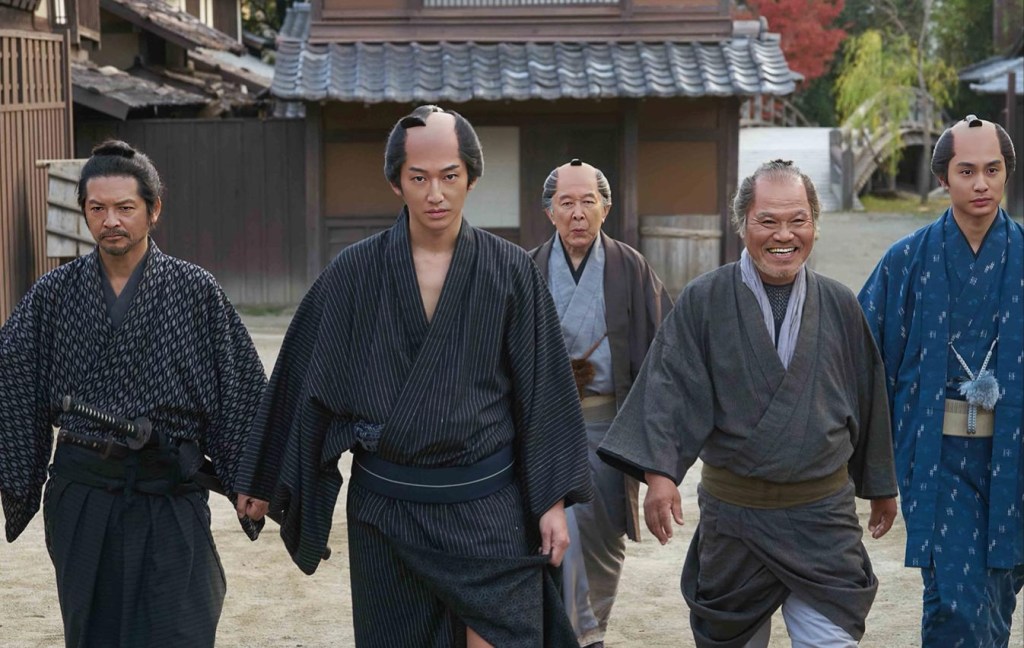
A young man gifted in swordsmanship but short in patience begs his teacher and his lord to allow him to travel to the neighboring domain to study swordsmanship further. Meanwhile, his clan leaders fear the annihilation of their entire domain after years of hiding fields, grain warehouses, and surplus funds from the Shogunate. These two plots will collide with the ugliest consequences as BUSHIDO unfolds.
Such circumstances bring to mind other productions: For instance, the hidden fields and crops in the NHK taiga drama NAOTORA, and the young swordsman desperate for a domain pass in the taiga, RYOMADEN. But these were indeed rather common occurrences at the time.
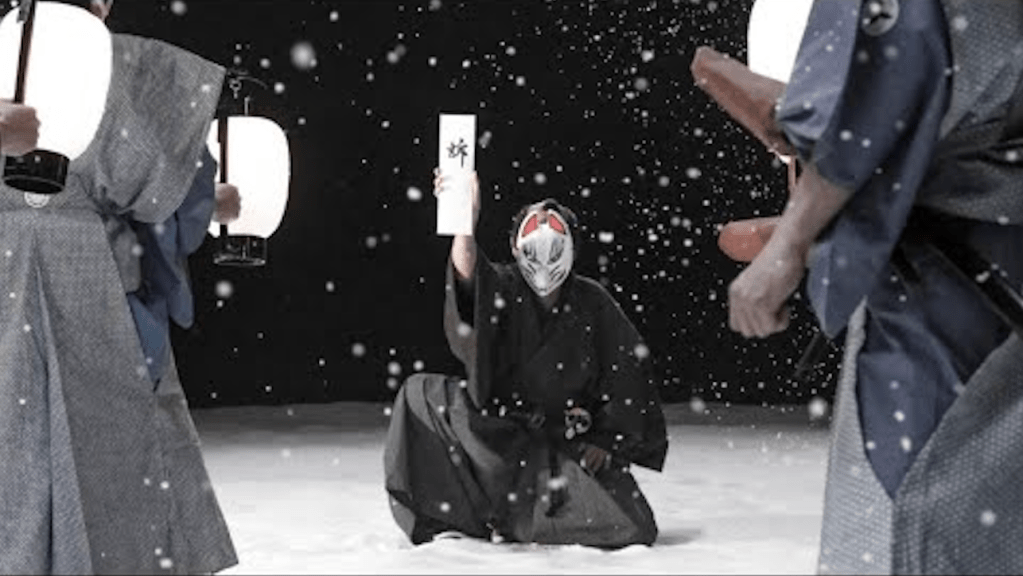
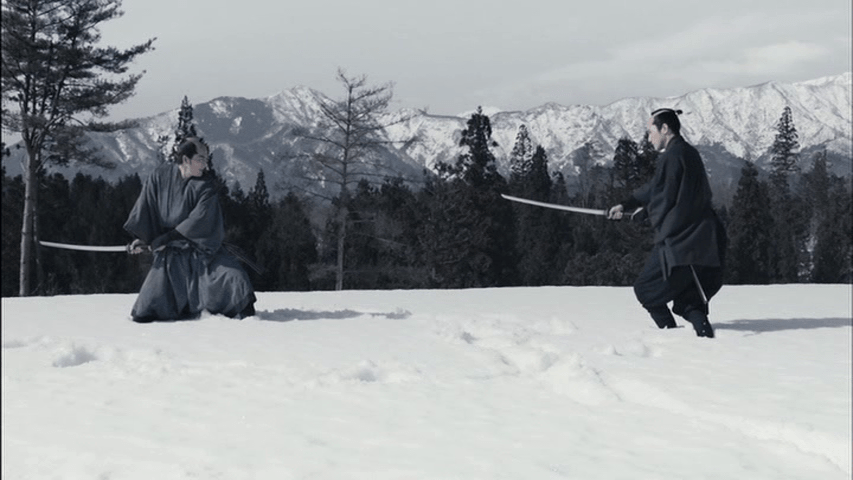
Director Yasuo Mikami films 95 percent of the movie in washed out colors bordering on black and white. Did he choose to do so because he knew the final act would feature endless fields of snow? The audience will feel surrounded by pale faces and grey vegetation for hours. An occasional orange hue breaks through by candle light.
All the higher ups act with minimalist performances bordering on the robotic. Tomohito Wakazaki’s performance as a wronged young man saves the film. He perfectly embodies all of Kagawa’s flaws and strengths as well as performing ably and believably the incredible stuntwork required. Tamao Sato brings warmth as his sister Yuki, and Takehiro Hira (SHOGUN, RENT A FAMILY) anchors the role of his teacher put into an impossible situation.
A malignant irony dwells at the center of the story: Kagawa is the son of a man who sacrificed himself for the clan a generation ago. And Kagawa is headstrong and unhappy because he always believed his father was wrong to give so much for the clan. His frustrated heart lands him into trouble when the clan lords return to the same well to save themselves.
Most samurais’ lives were grim. Bushido, the warrior’s code was grim. This film is nothing if not grim. It may not be your cup of tea, but it does not commit false advertising. Mikami does not rush the story. Most of the combat is verbal, but the final fight lives up to all the hype and can be compared with the greatest cinematic duels such as the climax of ROB ROY.
Limited series starring Shibata Kyohei, Iura Arata
In this cold case murder mystery, a middle aged cop finds his elder mentor is at the center of the mystery. Further, the cold case once reopened spawns new deaths.
Veteran Japanese actor Shibata Kyohei, known for his former onscreen detective persona and numerous guest roles (excellent as the dad in GUNSHI KANBEI) occupies the emotional heart of this mystery as retired detective Shibasaki Sachio.. The script gives him ample opportunity to express the grief he carries around as Job-like, he endures one loss after another. His junior, family man Kawasumi Shigekatsu, tries to square his professional duties with his loyalty to her mentor and savior. Iura Arata is one of those Japanese actors who turns up all over the place, playing serious and light fare, historical epics and modern dramas. He certainly has range. To date, the best performance that I have seen would be his role as the unlucky and haunted Emperor Sutoku in the NHK taiga drama, TAIRA NO KYOMORI. Usually encountered as a supporting actor, here he anchors much of the script while remaining the cipher through which the audience comes to grip with a complex storyline. Iura illuminates a slightly stooped, messily dressed dad and husband, tired, often impatient with his colleagues, his eyes hidden behind overgrown bangs.
A detailed multigenerational saga from Wowow studios, known for their grittier and glossier productions, it requires the viewers’ attention. On the one hand, that attention is repaid in spades by Shibata’s performance. On the other hand, without getting into spoilers, the resolution requires a certain amount of suspension of disbelief.
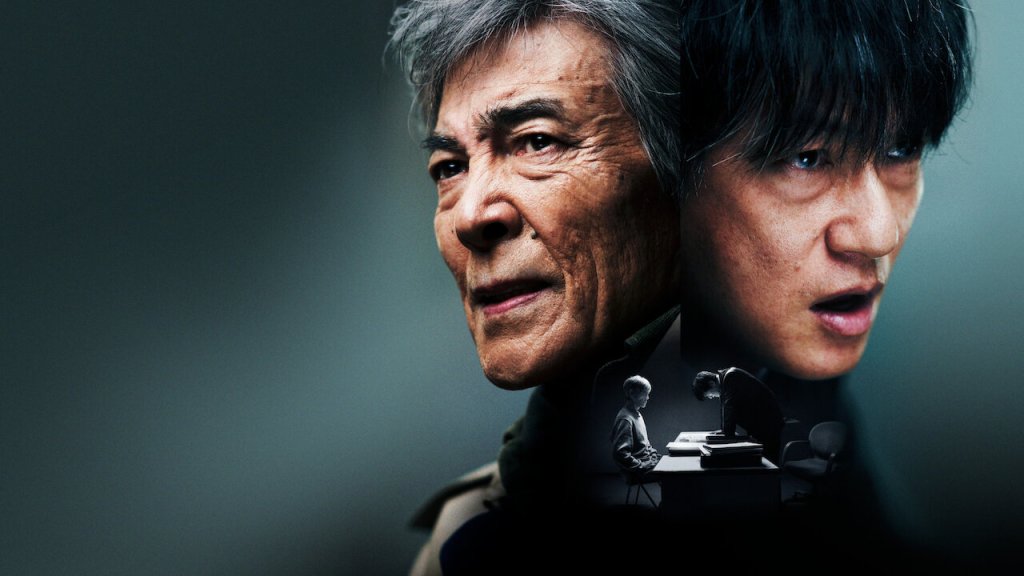
Based on a novel by Nakayama Shichiri which chronicles the travails of two young people, Tone and Mikiko, whose world is violently wrenched from them by the 2011 earthquake and tsunami leaving them orphans and throwing them together. It also boldly tells a story of a series of grisly murders occurring years later. The film flashes backward and forward in time as we learn about these survivors and observe the shadows cast by their suffering and hope.
Abe Hiroshi is perfect as the lonely and bereft detective who sees the case through to its bitter end. He is just engaged enough emotionally in events for us to know that he is processing his own loss through them.
Satoh Takeru effectively plays Tone as constantly rattled and living on a hair trigger. Kiyohara Kaya plays the adult Mikoko, now an idealistic but frustrated young welfare officer. Her edgy performance keeps you guessing: Is she aggressively compassionate? Or compassionately aggressive? The chemistry between Abe and Kiyohara is electric. Years later, they would reunite in LAST SAMURAI STANDING, where, as the ancient vengeful warrior Ikusagami, he would haunt her steps in relentless pursuit.
Surprisingly, Japanese film stars Yoshioka Hidetaka and Nagayama Eita show up as relatively minor characters. But they accomplish much with their limited screen time.
An hour and a half into the film, we find Mikiko saying: “You have to ask for help. If you do, someone will respond. There’s still hope. Someone will reach out to you.” Does she still believe her own words? Yet this poetry ties together all the threads of disaster, survival, survivor’s guilt, poverty, charity, security, and a broken welfare system.
The fulcrum of the story is Kei, an old woman and fellow tsunami survivor looking after Tone and Mikoko. Misuko Baisho plays her memorably with compassion and fragility (an interesting contrast to her evil clan matriarch in GANNIBAL). It was the novelist’s flash of genius to tell two stories through Kei’s suffering and unite those stories into a compelling mystery.
Director Zeze Takahisa succeeds in bringing book to screen in an all-star, big budget production. Unlike so many other films, it does not suffer from its many time jumps; its editing and pacing are solely beholden to the storytelling.


 REEL JAPAN